Complementary and Substitute Goods
|
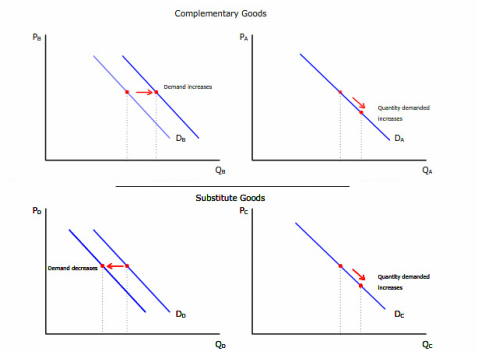
Complementary good: a product that is used or consumed jointly with another product. Such a good usually has more value when paired with its complement than when used separately.
IN OTHER WORDS... An object that is paired with another item; they are usually purchased together rather than separately. |
Substitute good: product that satisfies the same basic want as another product. Substitute goods may be used in place of one another.
IN OTHER WORDS... An object that can take the place of another item, which are essentially similar in use. |
Real-life Scenarios:

Hot dog wieners vs. Hot dog buns
Complementary If prices go up for hotdog wieners, consumers would most likely buy less of the hotdog buns as well. Since these two products are related to each other, if there is an increase/decrease in price for one, it would affect the other’s likelihood of being bought as well. |

Blueberries vs. Strawberries
Substitute If prices go up for blueberries, consumers could potentially substitute them for strawberries, whose price either remained unchanged or even decreased. In this way, strawberries would be the substitute good for blueberries because the price of one affects the quantity demanded of the other. |
Why is this important?
For both complementary and substitute goods, the concepts envelope a constancy within the real world. Both phenomenons occur in relative with each other. This helps economists factor out the reasoning behind why price dropping/rising affect other products that are similar or related to the original.
For both complementary and substitute goods, the concepts envelope a constancy within the real world. Both phenomenons occur in relative with each other. This helps economists factor out the reasoning behind why price dropping/rising affect other products that are similar or related to the original.
Summary
Let's review complementary and substitute goods...
Complementary goods: demand for one complementary good increases and decreases along with demand for the other; if price of one good decreased the demand would increase. Thus, the demand for the paired object would also increase (if price remained unchanged).
Substitute goods: change in price of one product in pair of substitute goods can cause demand curve for other good to shift. If price goes up for one thing, the other product will usually increase in quantity of demand because people will pay for the cheaper of the two.
These two types of goods help determine why certain products are affected when others' prices fall or go up. These determinants help economists review the price differences and set up a way for both sides to benefit (complementary) or contribute to the competition (substitute).
Complementary goods: demand for one complementary good increases and decreases along with demand for the other; if price of one good decreased the demand would increase. Thus, the demand for the paired object would also increase (if price remained unchanged).
Substitute goods: change in price of one product in pair of substitute goods can cause demand curve for other good to shift. If price goes up for one thing, the other product will usually increase in quantity of demand because people will pay for the cheaper of the two.
These two types of goods help determine why certain products are affected when others' prices fall or go up. These determinants help economists review the price differences and set up a way for both sides to benefit (complementary) or contribute to the competition (substitute).
